
Executive Summary
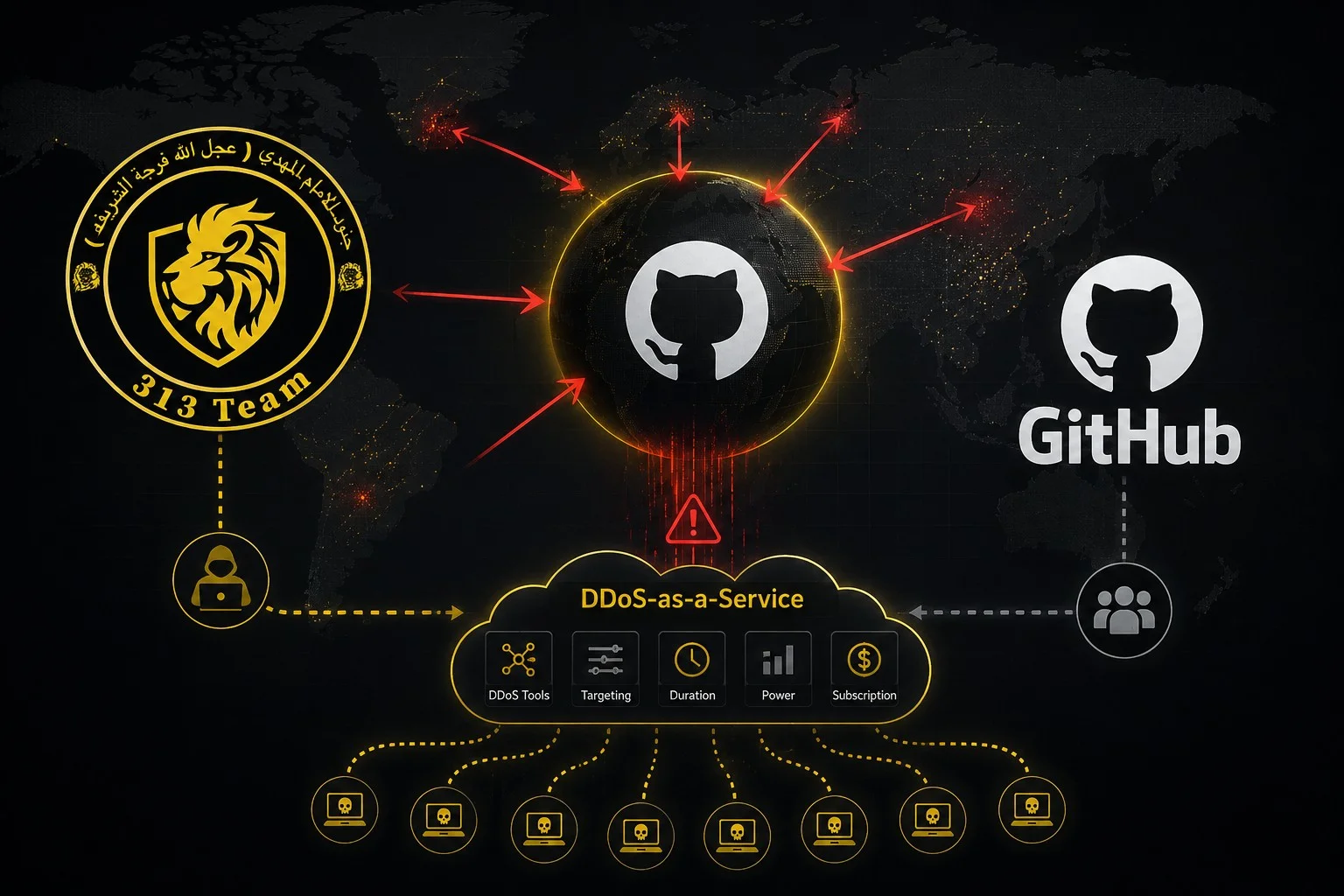
313 Team, an actor presenting itself as part of the Islamic Cyber Resistance in Iraq, claimed responsibility for a prolonged denial-of-service offensive against GitHub while the U.S.-based platform was experiencing a significant and independently verifiable degradation affecting multiple services.
The actor initially announced a 30-minute attack against “sensitive endpoints” within GitHub and subsequently published several updates claiming that the operation had been maintained and extended in additional 30-minute intervals. During that sequence, 313 Team claimed to have affected login functionality, project downloads, Pull Requests and, later, API Requests, Actions, Webhooks, Copilot and Git functionality.
Independent evidence confirms that GitHub was experiencing a genuine service disruption during the claimed attack window. GitHub officially opened an incident at 13:40 UTC on August 17 and documented progressive degradation affecting API Requests, Actions, Webhooks, Issues, Pull Requests, Copilot, Git Operations and Pages. At 15:42 UTC, the company reported error rates approaching 20% across multiple web experiences and API traffic, approximately 50% errors affecting file downloads and raw content, as well as disruption involving SAML, OIDC, SCIM and Team Sync.
A Check-Host test used by 313 Team itself provides a second layer of corroboration. At 14:17:20 UTC, Check-Host recorded HTTP 503 Service Unavailable responses for github.com/login from a geographically diverse set of monitoring nodes.
However, none of this evidence establishes that 313 Team caused GitHub's degradation. At the time of this analysis, GitHub had not yet published a root cause, and several services that the actor later claimed to have disrupted were already listed as affected on GitHub's official status page.
The case is particularly relevant because it illustrates one of the central problems in attributing DDoS activity during an ongoing incident: an actor claim may coincide with a real operational effect without that correlation being sufficient to determine whether the actor caused the incident, contributed additional pressure to a disruption originating elsewhere, or simply exploited observable downtime to construct a narrative of operational success.
Key Judgments
- 313 Team was actively monitoring GitHub's availability during the claimed operation and adapting its public communications as the platform's condition changed.
- The sequence is compatible both with an active DDoS operation and with the propagandistic exploitation of a pre-existing degradation. These possibilities are not mutually exclusive.
- A concurrent DDoS attack could have added pressure to a platform already experiencing problems from another cause without necessarily constituting the primary origin of the incident.
- The use of stresser services such as Cypher, which has been used by the actor, illustrates a model in which hacktivist actors can externalize a significant portion of the infrastructure required to generate availability pressure, weakening the traditional relationship between indigenous technical sophistication and potential impact.
- The business impact of degrading a platform such as GitHub can propagate far beyond the company itself, affecting development workflows, continuous integration, automation, enterprise authentication and software deployment processes that depend on its services.
A Claim That Evolves Alongside the Incident
313 Team's initial publication attributed what it described as a “massive and advanced cyberattack” against sensitive GitHub endpoints to the group and claimed that the operation had affected the login interface, Pull Requests, project downloads and other functions. The actor initially announced a 30-minute duration and published an external Check-Host report as supporting evidence.
That report confirms an objective condition: on August 17 at 14:17:20 UTC, github.com/login was returning 503 Service Unavailable responses from dozens of globally distributed monitoring locations, including nodes in the United States, Europe, Asia, Latin America and the Tor network.
Screenshots provided by 313 Team are consistent with a degraded service. One shows a repository where GitHub reports that it cannot retrieve the latest commit; another displays the platform's unavailability page when attempting to access the login interface.
But these elements establish the existence of the effect, not responsibility for causing it. GitHub had already opened its own incident at 13:40 UTC, 37 minutes before the Check-Host test retained by 313 Team. By 13:41, GitHub was already reporting degradation affecting API Requests; at 13:42, Actions; at 13:44, Webhooks; and by approximately 13:45, error rates of around 20% across multiple experiences. That chronology prevents causality from being established solely on the basis of the actor's claim.
What differentiates this case from a single retrospective self-attribution is what happened next.
313 Team published an initial update stating that GitHub had restored the login interface but claimed that the offensive was continuing against endpoints affecting downloads, Pull Requests and other functions.
The actor subsequently announced an additional 30-minute extension and claimed that it continued targeting critical endpoints while GitHub was experiencing increasing degradation.
In a third update, 313 Team claimed that additional endpoints had been added to the operation and attributed disruption affecting API, Actions, Webhooks, Copilot and Git functionality to that expansion, once again extending the alleged attack by another 30 minutes.
The sequence reflects a dynamic that is unusual for a purely retrospective claim:
declared attack → external verification → observed partial recovery → declared continuation
→ extension → declared expansion to additional endpoints → further extension
The actor did not simply state that “GitHub is down”. It narrated the alleged operation while the platform's condition was evolving.
Control of the Attack or Control of the Narrative?
That behavior introduces an important intelligence question: was 313 Team observing the real-time effects of an operation it was actually controlling, or was it monitoring a public incident and progressively incorporating observable failures into its own claim?
There is currently insufficient evidence to answer that question conclusively.
Several of the functions later mentioned by 313 Team had already been publicly acknowledged by GitHub before the actor claimed to have disrupted them through additional endpoint targeting.
GitHub recorded problems affecting Actions from 13:42 UTC, Webhooks from 13:44, Copilot from 14:31, Pull Requests from 13:58 and API Requests from the beginning of the incident. Git Operations later also entered a degraded state at 15:21 UTC.
This creates at least three plausible scenarios. In the first, 313 Team was generating a material portion of the traffic responsible for the degradation. In the second, the actor was attacking GitHub during an incident initiated by another cause, adding load to infrastructure that was already under pressure. In the third, 313 Team was actively monitoring GitHub's condition and progressively appropriating failures that were publicly observable.
INFERENCE (confidence: medium-high): The third scenario must remain particularly open because the actor's communication demonstrates an ability to track the evolution of the incident but provides no technical evidence capable of distinguishing observation from causation.
At the same time, this hypothesis does not automatically invalidate the possibility of genuine offensive traffic.
A platform can simultaneously experience an internal failure and external DDoS traffic. Under that scenario, the attacker would not necessarily be responsible for the root cause but could still increase mitigation costs, delay recovery or partially expand the impact.
Attribution should therefore not be framed as a binary choice between “313 Team took GitHub down” and “313 Team did nothing”.
GitHub as an Impact Multiplier
GitHub constitutes de facto infrastructure for the global software-development ecosystem.
During this incident, the impact was not limited to a login page. GitHub reported degradation affecting Pull Requests, Issues, Actions, Webhooks, API Requests, Copilot, Git Operations and Pages. It also reported approximately 50% error rates affecting file downloads and raw content, as well as disruption involving enterprise identity and synchronization mechanisms.
For that reason, translating the event directly into a statement such as “GitHub lost X dollars” would be methodologically unsound.
There is insufficient public information to determine how much of the unavailability can be attributed to the alleged attack, how many customers experienced complete disruption, or which workflows were affected and for how long.
The economically relevant impact is more distributed.
A GitHub degradation can propagate across multiple dependencies:
repository access
→ Pull Requests
→ APIs
→ GitHub Actions
→ Webhooks
→ CI/CD pipelines
→ automation
→ releases and deployments
Even a relatively short interruption can result in developers waiting, builds being halted, automation failing, deployments being delayed, operational tasks being repeated and technical teams spending time diagnosing a problem whose origin lies outside their own infrastructure.
INFERENCE (confidence: high): The potential business cost of degrading a development platform is multiplicative because part of the impact is transferred from the service provider to the organizations that depend on it to execute internal processes.
This characteristic makes platforms such as GitHub especially attractive from a hacktivist perspective: even partial disruption can generate a perceived level of impact far greater than the infrastructure required to produce it.
The Difficulty of Attributing DDoS in Real Time
The episode also provides a particularly clear example of the limits of intelligence derived exclusively from public evidence.
At least three independent layers are currently observable:
- 313 Team claims that it is attacking GitHub.
- Check-Host confirms that one of the endpoints identified by the actor returned
503 Service Unavailableglobally during the claimed attack window. - GitHub confirms severe, multi-component degradation during the same period.
The decisive layer is still missing: evidence technically connecting traffic generated by 313 Team or Cypher to the cause of the incident.
That would require information likely available only to GitHub and its defensive providers: traffic patterns, source distribution, volume, mitigation behavior, resource saturation and the final diagnostic assessment of the incident.
Until that information becomes available, the relationship should remain classified as temporal correlation accompanied by active self-attribution. Not as confirmed causation.
Analytical Closing
The intelligence value of this episode does not depend on 313 Team ultimately being identified as the primary cause of the degradation.
If GitHub determines that the incident originated from an internal failure, it would still remain relevant to establish whether 313 Team was genuinely sending offensive traffic during that window and whether it used an already degraded infrastructure as an operational and propaganda opportunity.
If GitHub identifies malicious traffic or DDoS activity as a causal factor, the combination of prior self-attribution, real-time monitoring, successive extensions and external verification would carry substantially greater attribution weight.
For now, the available evidence supports a more limited, but still significant, conclusion.
Explore 3C-INT
Expand actor, campaign and operational-link tracking through a structured intelligence layer.
Get new publications
Subscribe to receive new articles and public updates from iQBlack without unnecessary noise.