
Executive summary
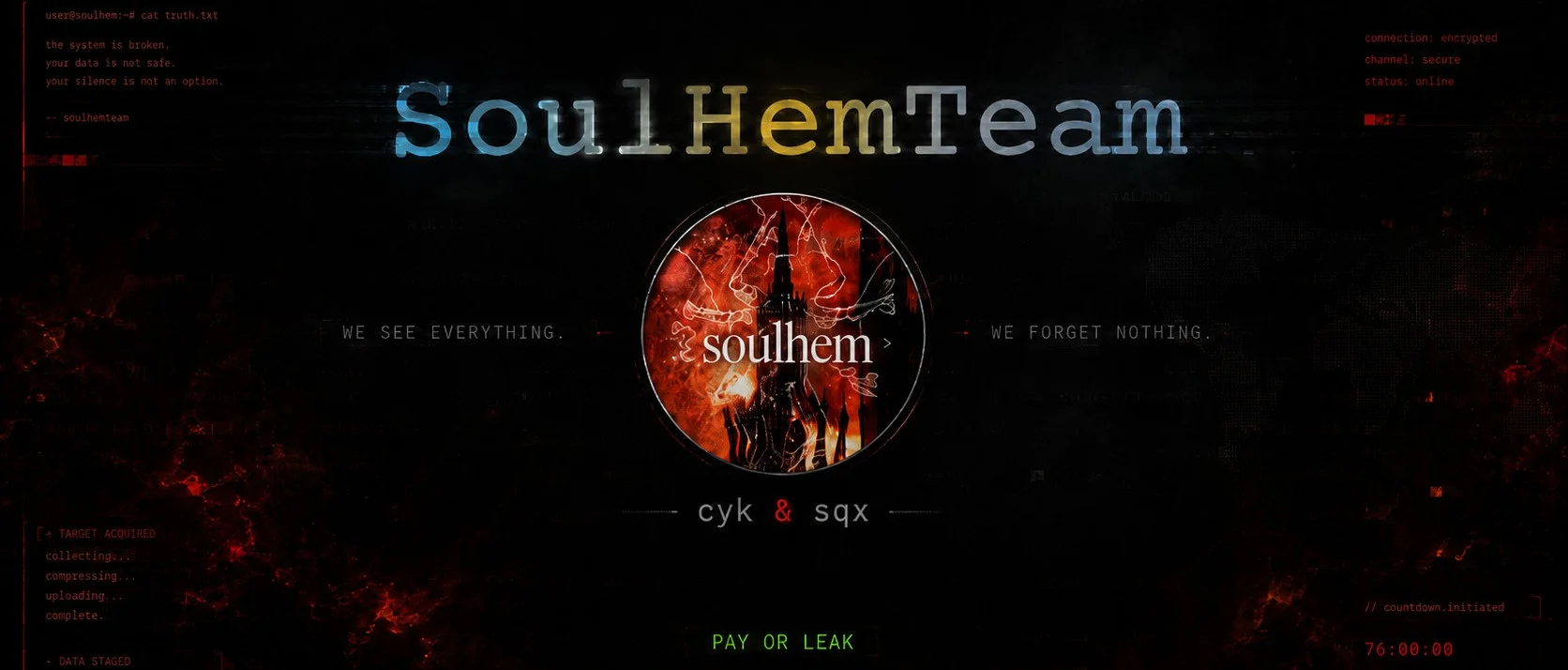
SoulHemTeam published a message in which it states that it previously carried out a defacement against a management portal associated with Lotería de Santa Fe and claims to maintain control over a page used to manage player data. The actor threatens to reveal approximately 5.6 GB of information if the demanded payment is not made.
The screenshot shared by the actor mentions player data, payments, and other information associated with the portal’s operation. At the time of review, iQBlack did not identify publicly indexed signals that would allow independent confirmation of the defacement, the persistence of access, the declared volume, or the contents of the alleged database.
The case sits on a sensitive surface: official gambling, management portals, personal data, and payment flows. Lotería de Santa Fe publicly presents itself as Caja de Asistencia Social – Lotería de Santa Fe, with institutional operations linked to official games and public service channels. The institution itself has historically documented digital workflows for agents, including access to systems associated with procedures and prize payments, where data related to bettors or winners may be involved.
Key judgments
- The publication is interpreted as activity declared by SoulHemTeam, not as independent confirmation of compromise.
- The main intelligence value is not focused solely on the alleged defacement. The greater weight lies in the threat to expose data linked to players and payments.
- The mention of 5.6 GB of information increases reputational pressure and extortion credibility, although the volume and contents remain unverified.
- The case exposes a risk surface where management systems, personal data, gambling activity, and payments may converge within the same declared incident.
What happened
SoulHemTeam states that, after a period of inactivity, it decided to “resume some things” and that some time ago it carried out a defacement against the Lotería de Santa Fe management page. The actor attributes that defacement to two aliases, described as group members, mentioned in the message, and says it was done to demonstrate control over the site.
The publication points to the portal gestion[.]loteriasantafe[.]gov[.]ar/app and states that the page is allegedly used to manage player data. According to the actor, the material in its possession would include around 5.6 GB of information, with data on players, payments, and other unspecified elements. It also states that the information is “complete” and threatens to reveal it if the demanded amount is not paid.
This framing combines three components often seen in extortion-pressure operations: prior visual proof, a statement of sustained control, and a threat to publish data. Without additional evidence, those elements allow the actor’s narrative to be analyzed, but they do not confirm the real scope of access.
Analytical assessment
The relevant point is the possible exposure of a management platform linked to official gambling. In this type of surface, the potential impact does not depend only on site availability or on a visible defacement. It also depends on the nature of the data being managed, the relationship with users or players, payment flows, and the possibility of using exposed information for fraud, secondary extortion, social engineering, or reputational pressure.
The threat to publish player and payment information elevates the case beyond an isolated defacement. A defacement can function as a public signal of intrusion or as a tool of technical propaganda. The promise to reveal a data package, by contrast, shifts the episode toward a logic of exposure and monetization.
There is not enough public evidence to state that the access existed or remains active, that the declared volume exists, that the information is complete, or that the mentioned portal has a direct connection to critical internal systems. It also cannot be determined whether the alleged access corresponds to a recent intrusion, previously obtained material, or a recycled narrative intended to reactivate pressure.
Even with these limitations, the case has value as a signal. SoulHemTeam attempts to project capability against a provincial institutional target and turn an alleged intrusion into a mechanism of public pressure. The content of the message does not only seek to demonstrate access; it seeks to create urgency, affect trust, and increase the reputational cost of not responding.
Analytical closing
The SoulHemTeam–Lotería de Santa Fe case shows how a declared defacement can be used as the narrative prelude to a leak threat.
The central question is not only whether a page was modified. The question is what data could be linked to that surface, what value it would have for third parties, and how an actor can turn a screenshot, a URL, and a number of gigabytes into extortion pressure.
For now, the signal is public. Validation remains pending.
Explore 3C-INT
Expand actor, campaign and operational-link tracking through a structured intelligence layer.
Get new publications
Subscribe to receive new articles and public updates from iQBlack without unnecessary noise.